 Enjoying Native Organic Landscapes
The author of the introduction below is Dr. David Dobbins, Emeritus Professor of Plant Anatomy and Development, Morphology and Horticulture at Millersville University in Millersville, Pennsylvania. Following are seven easy steps to native organic landscaping. Enjoy the wildly beautiful environment that so restoratively awes and sustains us! -Aggie Perilli
September 2026 Update
By Dr. David Dobbins
I grew up in the city of Indianapolis, with little exposure to nature, and had no real interest in our environment. All of that changed when I went camping with the Boy Scouts in Indiana, Kentucky, Ohio and Illinois.
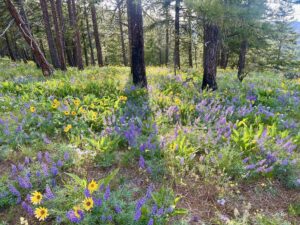
Photograph by Chris Guiles
Camping inspired my enthusiasm for nature, and, also, my career as a researcher and a professor of biology, botany, horticulture and environmental science.
For 20 years, I engaged in research in the rain forests of Australia and Central and South America. While studying and teaching, my mind kept returning to the same question: “How had we allowed our world to become so nonbiological and unnatural?”
Throughout my career, I’ve noticed stark changes in people’s attitudes. In our headlong rush to raise our standard of living, we have completely shortchanged our quality of life.
We bought houses with lawns we admire, but have little idea how to healthfully maintain.
Chemically sprayed lawns consist of a single species of grass. No thriving ecosystem in the world consists of a single species!
To maintain what is unnatural, some people and organizations poison their grass with increasingly toxic herbicides, fungicides, and insecticides linked with deadly diseases. Further, carbon-releasing herbicides and synthetic fertilizers (and pesticides) that emit greenhouse gases from manufacture through application may be accountable for more than a third of climate change.
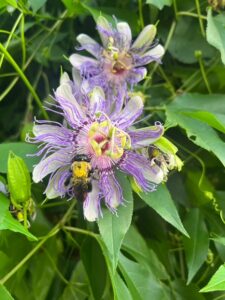
My neighbor, Lisa, replaced half her front and back lawns with stunning native organic pollinator plants, and a bountiful food garden.
Fighting against nature has led to the wholesale pollution of our air and soil, streams, rivers, ponds, lakes and coastal areas. It has also jeopardized the safety and well-being of humans, and our essential forests, plants, and wildlife that includes pollinators.
How do we restore and protect our natural environment? Plant native organic woods, tall meadow grasses and wildflower-rain gardens. These healthy ecosystems provide safe habitats for the diverse organisms that comprise the bulk of our food chain.
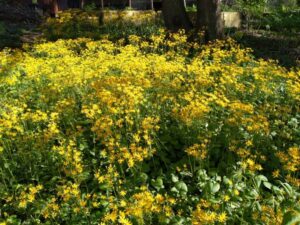
My neighbor, Katherine, replaced all her front and back lawns with gorgeous native organic pollinator flowers and plants.
In suburban areas where lawns may still the landscaping standard, ensure property maintenance is chemical free. Like wild parks, organic landscapes are most beautiful and allow all life to thrive.
Create Native Organic Landscapes in 7 Easy Steps
By Aggie Perilli
1. Allow chemically addicted landscapes to lie fallow for up to three years to withdraw from their destructive chemical dependency.
Raise your standards. Enjoy the restorative tranquility of wildly beautiful organic parks in your own yard and community.
2. Never apply treatments without testing your soil to determine what, if any, nutrients it needs. Keep your property safely organic!
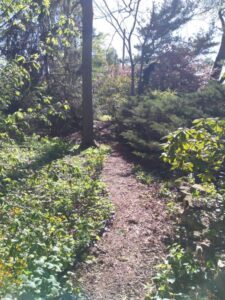
A bark path leading from the front of Katherine’s house, to the back.
Many states test soil at no charge. In Pennsylvania, you can buy a $9 testing kit at the county offices of Penn State’s College of Agricultural Sciences and submit your soil samples for a free analysis. Tips for organic landscape management can be found on the Beyond Pesticides and Nontoxic Communities websites.
3. If your soil is compacted, aerate it and improve your land’s natural drainage and vitality.
Use an aerator with hollow tines. Solid tines may further compact your soil. Aeration or oxygenation in richly alive organic soil can sustain itself.
4. Transform all or part of dull and unhelpful lawns into inspiring wildlife habitats!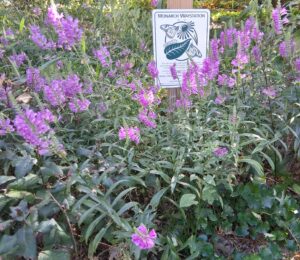
Create corridors of certified gardens that attract and protect our pollinators and wildlife. It’s easy and fun to provide the four elements needed: food, water, shelter and sustainable homes. The National Wildlife Federation (NWF) provides a certification checklist to help you meet wildlife-habitat requirements. Once you’ve met the requirements, obtain a certification sign to spread the word and inspire your neighbors.
Beyond the NWF checklist, in controlling non-native species, keep your habitat organic and chemical-free. Avoid carcinogenic and other costly carbon-releasing killing agents linked to deadly diseases, dysfunctions and climate change. Regardless of how many natives are planted, killing agents repel and kill our essential pollinators. Further, they kill the healthy microorganisms in richly alive soil, and poison our air and water.
Eliminate equally addictive synthetic fertilizers that emit greenhouse gases from manufacture through application. Rather than prevent weeds, killing agents also found in synthetic fertilizers counterproductively create the deadening conditions that cause weeds to spread.
 5. Hand weed and grow organic native trees and unsprayed self-seeding meadow grasses and pollinator flowers and plants. Use autumn leaves as mulch.
To reduce the need for hand weeding and mulch that can attract termites, plant native woods, ground-cover shrubs, and fields of pollinators. In autumn, cost-effectively apply fallen leaves as mulch. This adds a balance of nutrients, and allows the beneficial insects who live in fallen leaves to thrive.
Shop at organic nurseries that sell seeds and plants that are uncoated and unsprayed.
If your garden has poisonous weeds you may be allergic to, place your weeding hand in two solid bags that extend past your elbow. Pull the weeds and place them in an opened garbage bag. From the top, slip the weeding bags off your arm and into the garbage and avoid skin contact.
6. Avoid weakening your property by micromanaging it.
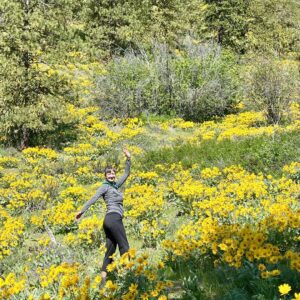
My sister-in-law, Laurel Brown, hikes through a wildly beautiful park so popular, she has to leave early to avoid crowds. Photograph by my brother-in-law, Chris Guiles.
Allow grass to grow as tall as municipal law allows. Leave your grass with nutrient-rich blades tall enough to shade out weed seeds. A thick and healthy turf can sustain itself.
7. In autumn, seed or over-seed your lawn — or just areas that are weedy or bare.
Buy safely organic uncoated seeds suited to your soil, climate and land use. Be sure to select seed varieties native to your area.
As we shift to safely organic native landscapes, encourage land owners and landscapers to persevere.
It may take up to 3 years for a chemically deadened property to return to its wildly beautiful nature.
How is organic landscaping (and agriculture) raising the quality of all life in your area?
Aggie Perilli is president of Aggie Perilli Communications International (APCI).
Note: If you have found this post helpful, you can subscribe to my blog here at no charge. Thank you for attracting and protecting pollinators and wildlife in your area!
Recommended Media
Beyond Pesticides’ free Parks for a Sustainable Future program.
Products Compatible with Organic Landscape Management and Organic Lawn Care 101 by Beyond Pesticides.
Tools for Change from Non-Toxic Communities that thrive in wildly beautiful and cost-effective organic landscapes.
Alternatives to Synthetic Products for Managing Landscapes and Pests
New Alarm Bells About Chemicals and Cancer by Nicholas Kristof.
Pollinators Are in Trouble: Here Is How Transforming Your Lawn Into A Native Wildflower Habitat Can Help by Discover magazine.
Bringing Nature Home – How You Can Sustain Wildlife with Native Plants by Douglas W. Tallamy.
Documentaries: Down to Earth with Zac Efron, Kiss the Ground, and Groundswell with Woody Harrelson, and The Biggest Little Farm.
Organic Manifesto by Maria Rodale.
Silent Spring by Rachel Carson.